sola.
Guiding question
How can we show people without technical knowledge whether, and when, a solar installation pays off for them?
Summary
sola. is a holistic system that lowers the barrier to owning a photovoltaic system. A test kit measures how much sun and shade actually reach the roof. An app translates the readings into tangible terms like euros saved or loads of laundry, and calculates when a system would pay for itself. After purchase, an indicator clock in the living area shows yield, consumption and battery level at a glance, without anyone having to open the app.
Not a lack of interest, a lack of orientation
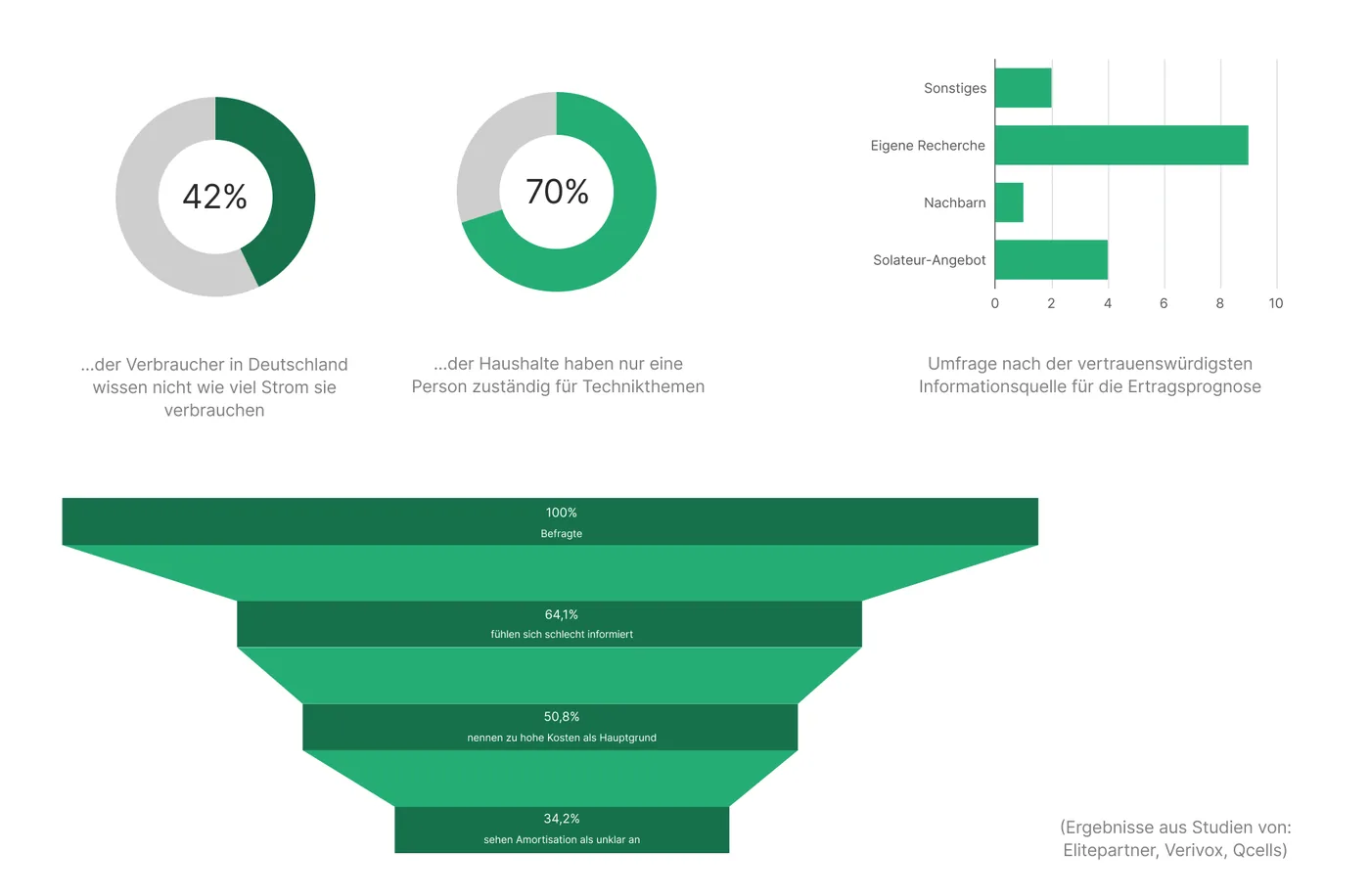
Many people want to take charge of their own energy supply but never make the decision. 64% of German homeowners feel poorly informed about solar (Civey/Qcells 2024), and new residential installations dropped by around 28% in 2025. Things stay unclear after the purchase too: in our own survey, only one person kept track of the yield in about 71% of households, and over half rarely or never use their solar app.
We mapped the life cycle of a solar installation in storyboards, from the first impulse to years of use, analysed studies and ran our own surveys. Two phases turned out to be decisive: the purchase decision and everyday life afterwards.
Concept: measure instead of estimate, see instead of search
Online simulations fail on local details like the tree in the garden or a dormer window. The test kit therefore delivers real data from your own roof, at low risk. The app turns it into a personal calculation. The indicator solves the problem after purchase: instead of yet another dashboard, an everyday object, a clock, becomes a display for the whole family. Together, the three parts cover almost the entire life cycle, which no existing solution does so far.
From balloon to mesh
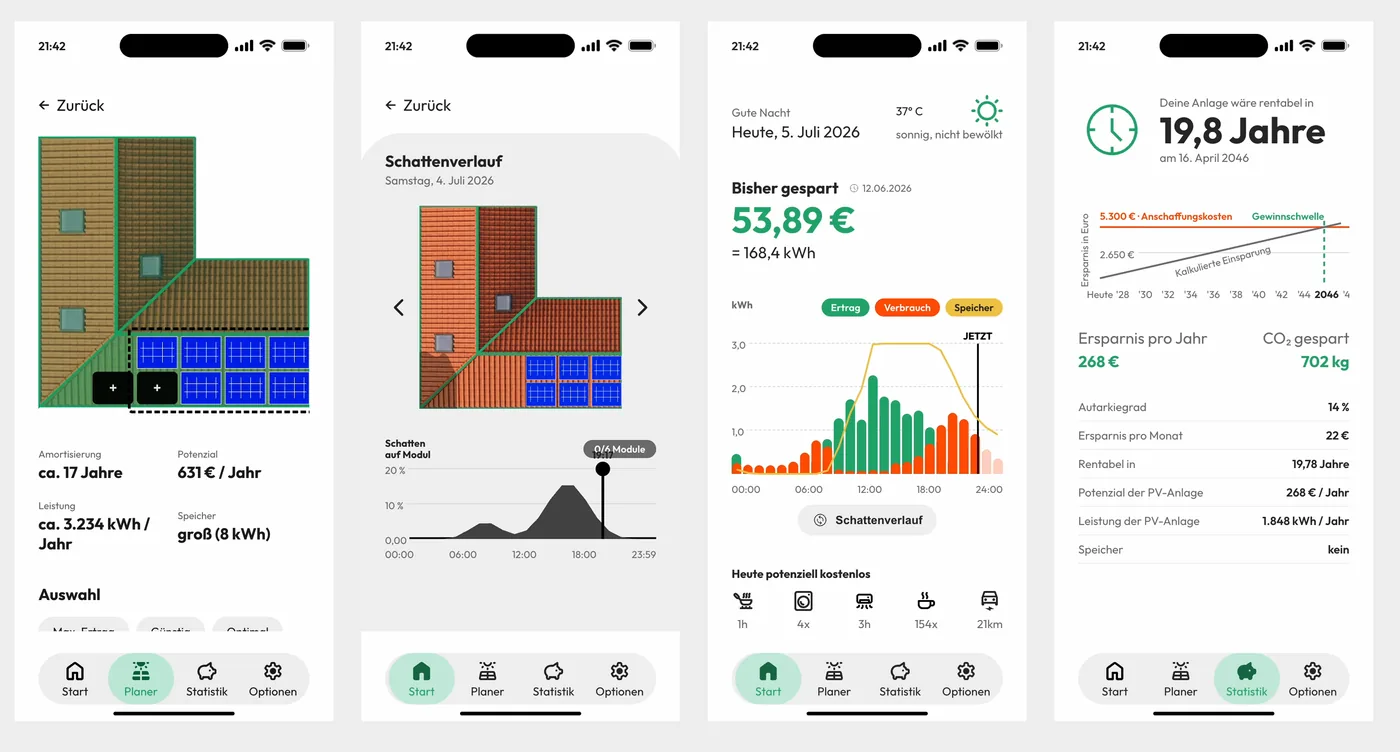
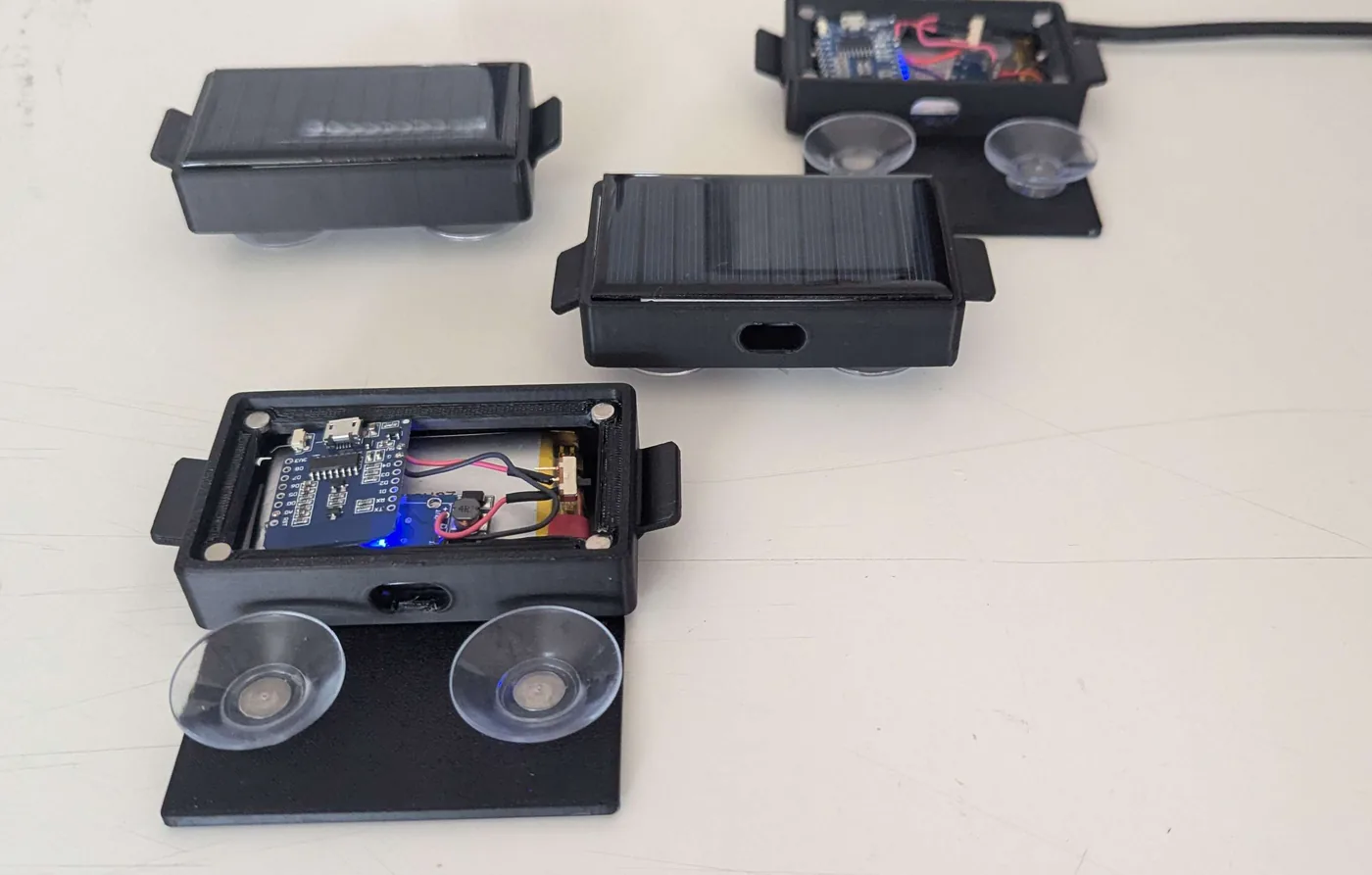
For the test kit we tried a wide range of techniques. All of them failed on field of view, stability or privacy. Our solution is a mesh of small, self-sufficient modules that attach directly to the roof with vacuum suction cups. Each module has a solar panel, an ESP microcontroller, a charge controller and a battery. Comparing the modules reveals how shade moves across the whole roof. In the final concept, a plug-in hub collects the data and connects it to smart-home systems via Zigbee. The app guides users through onboarding with a pairing code, shows in euros what a system would have saved today, plays back shadows moving across the roof in time-lapse, and calculates the payback period.
The clock: energy at a glance
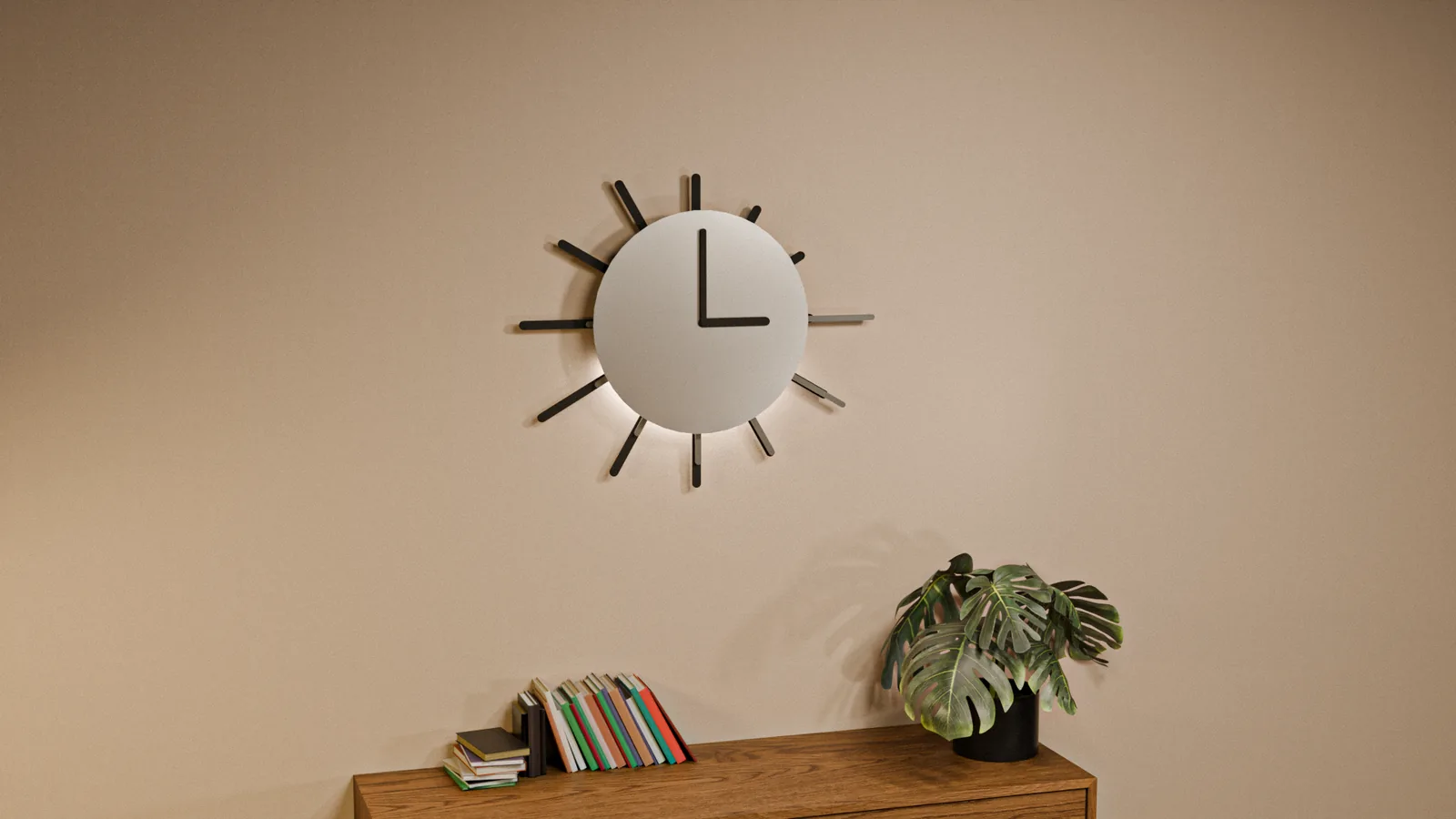
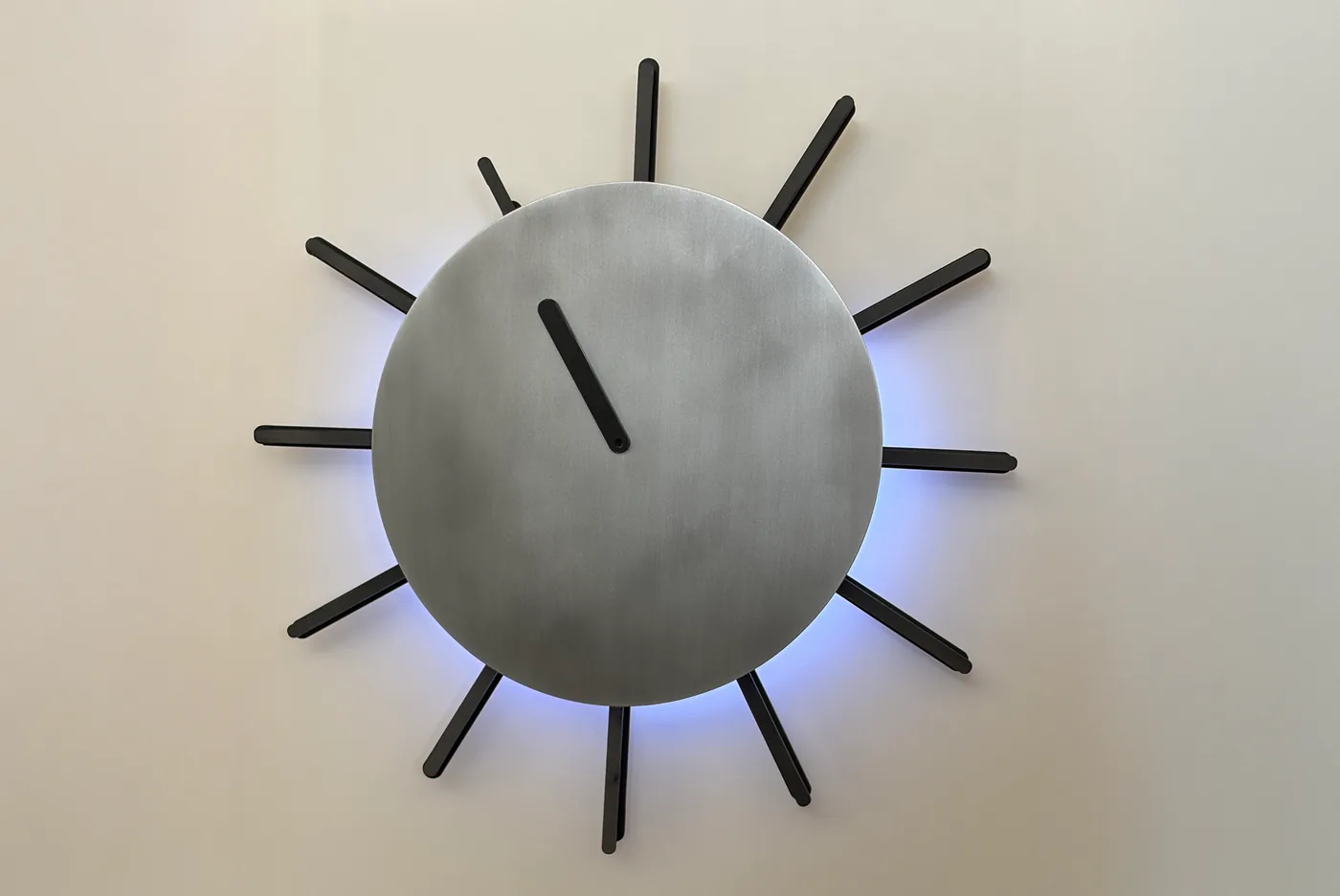
My focus was the indicator clock. For each hour it shows two beams: a thin, light one for current yield and a wide, dark one for current consumption, each with a 12-hour forecast. The gap between them shows whether power is being fed into the grid. A light ring fills up with the battery level. The first mechanism with 24 servos failed because their range of motion was too short. In the final build, two stepper motors on threaded rods move a magnetic carriage that pushes the beams, and a 360° servo rotates the module to the next hour. Felt holds the beams in place. Form prototypes made of chocolate, cardboard and 3D prints led to the final materials: brushed aluminium and sandblasted acrylic glass. All of this was based on the idea of calm technology.
Team, role and outlook
sola. was an interdisciplinary project (Interaction Design and Product Design) with Annika Feist, Tobias Wallisch and Leonard Zacke. I led the overall concept, ideation and user research and built most of the mechanical prototype of the indicator clock myself. I contributed to all other areas; the renderings were done by teammates.
The prototype proves the principle but isn’t a finished product: smart-home integration wasn’t feasible within the semester, and the clock mechanism would need to become more precise and robust for daily use.
Key data
- Courses
- Invention Design 1 + Product Design 3 · Summer 2026
- Supervisors
- Prof. Michael Schuster, Ron Jagodzinski
- Team
- 4 (Interaction + Product Design)
- My role
- Concept, research, physical prototyping (clock)
- Methods
- Storyboards, surveys, persona, Crazy 8s, user tests, form & material prototypes
- Tech
- ESP, Arduino, 3D printing, Fusion 360, Figma