IOCON
Guiding question
How can complex robot movements be combined into a single interface that stays precise and understandable across 384,400 kilometres?
Summary
IOCON is a controller for remotely operating a robot with a gripper arm, designed for a lunar surface exploration use case. Instead of many buttons, a ring-shaped steering wheel mounted on two parallelogram joints combines every function: driving, turning, lifting the arm and, by opening the ring, gripping. Two rounds of user testing led to a new solution for sideways movement. The result is a working prototype and a design model of a control station.
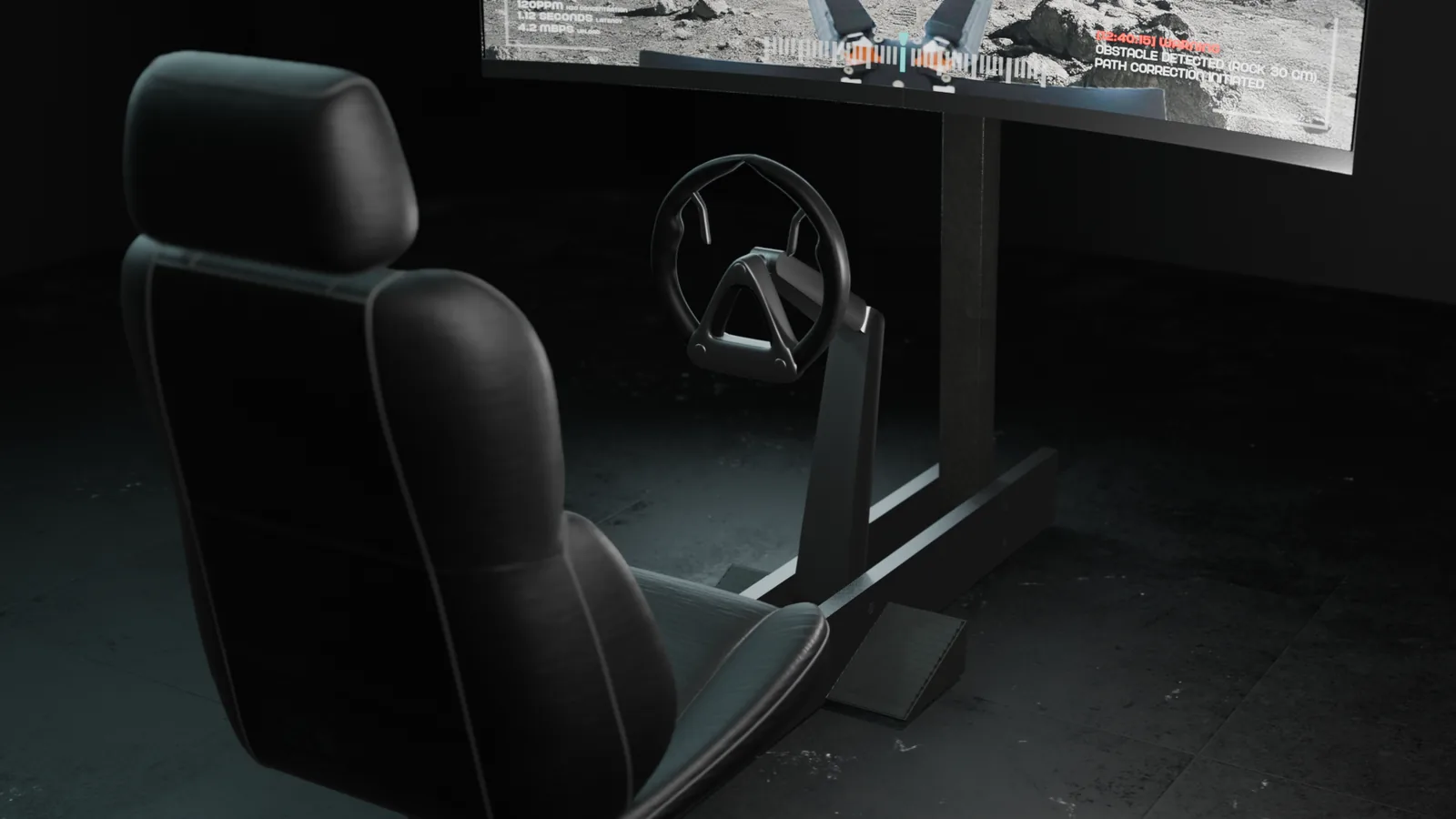
384,400 kilometres away
In the Interface 1 course, our task was to map the functions of a gripper robot onto a physical controller: forward and back, turning, sideways driving (crab walk), and lifting, opening and closing the arm. As a use case, we chose mission operators in a control centre on Earth who collect rock samples on the Moon, modelled on the work of ESA. At this distance latency is unavoidable, so the operator must always be able to see which movement is being executed.
Movement instead of buttons
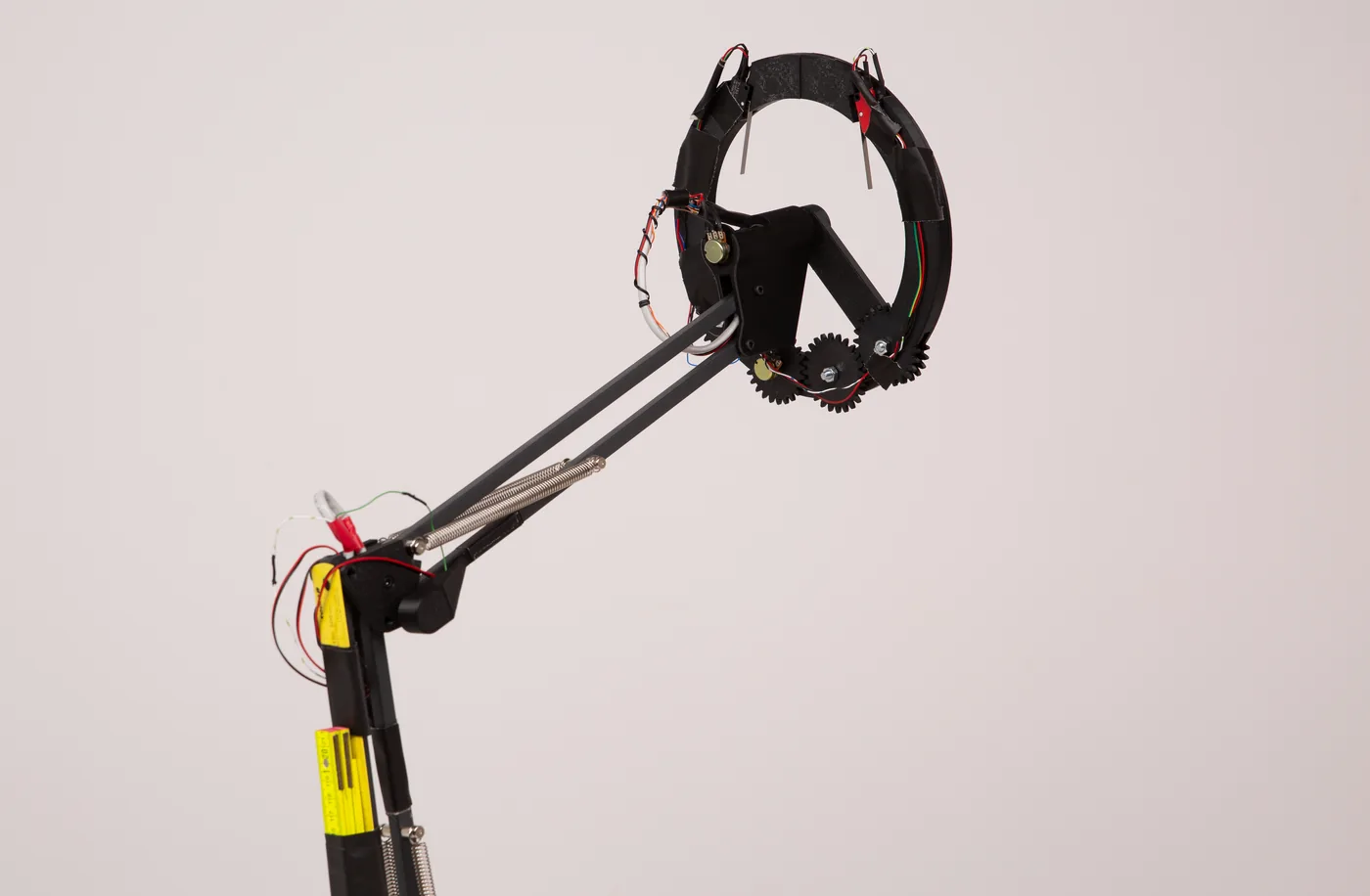
After several Crazy 8 sessions and references from helicopter, aircraft and racing-simulator controls, a ring-shaped element won out. Its strength is its simplicity: the ring can be turned, and hinges in its lower half let it open, just like the gripper. Inspired by a desk lamp, two parallelogram joints carry the wheel so it always stays parallel to the user. The lower joint controls forward and back, the upper one the height of the arm.
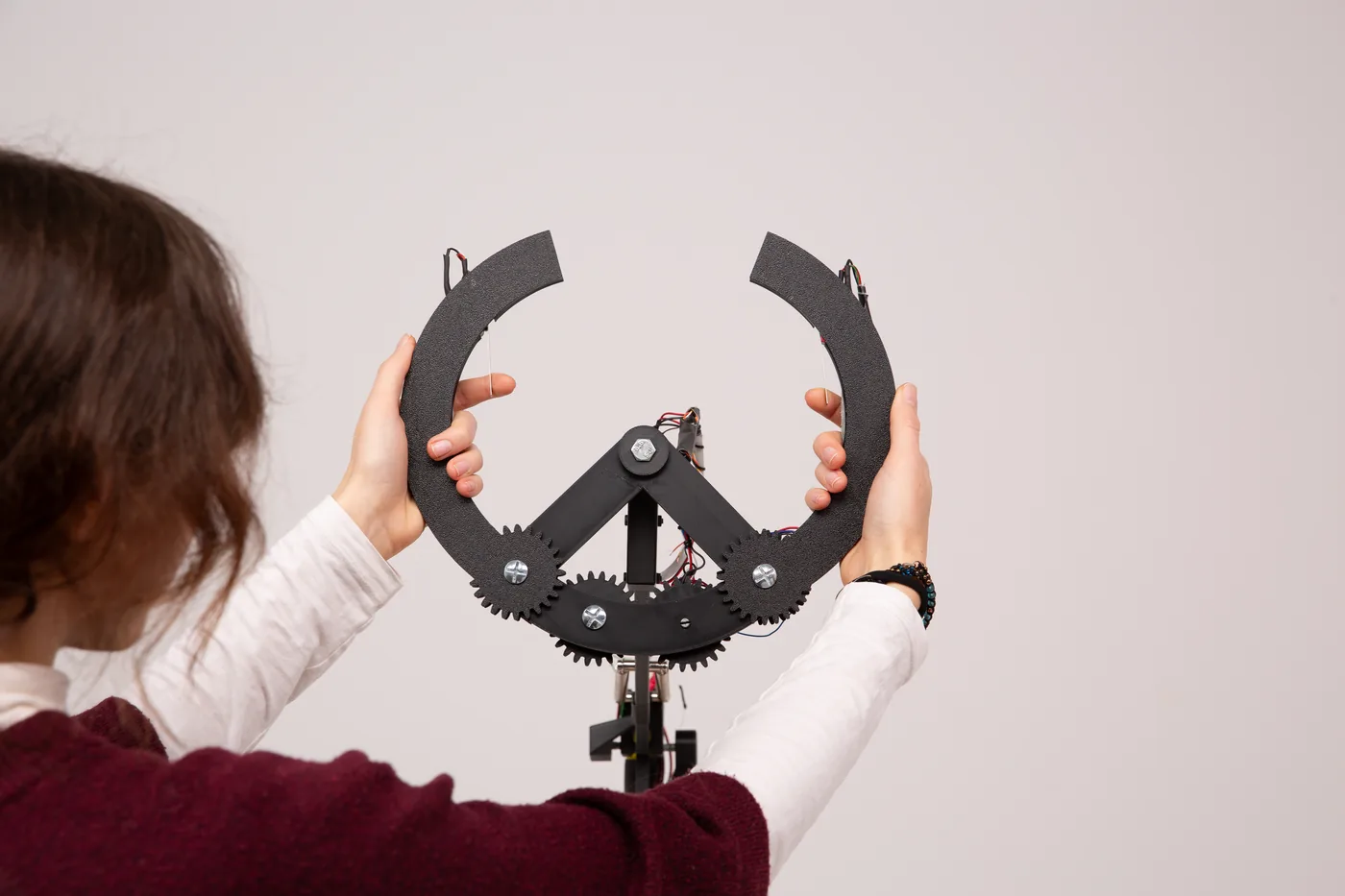
Cardboard, wood, potentiometers
I built the controller physically from the start. Early cardboard models helped us understand the opening mechanism. Next came a laser-cut wooden prototype, where gears make both halves of the ring open evenly. Potentiometers read the movements and a reed sensor detects the opening. Using Arduino and a mapping written in C, the controller drove a robot simulation. Laser cutting and 3D printing were completely new to me.
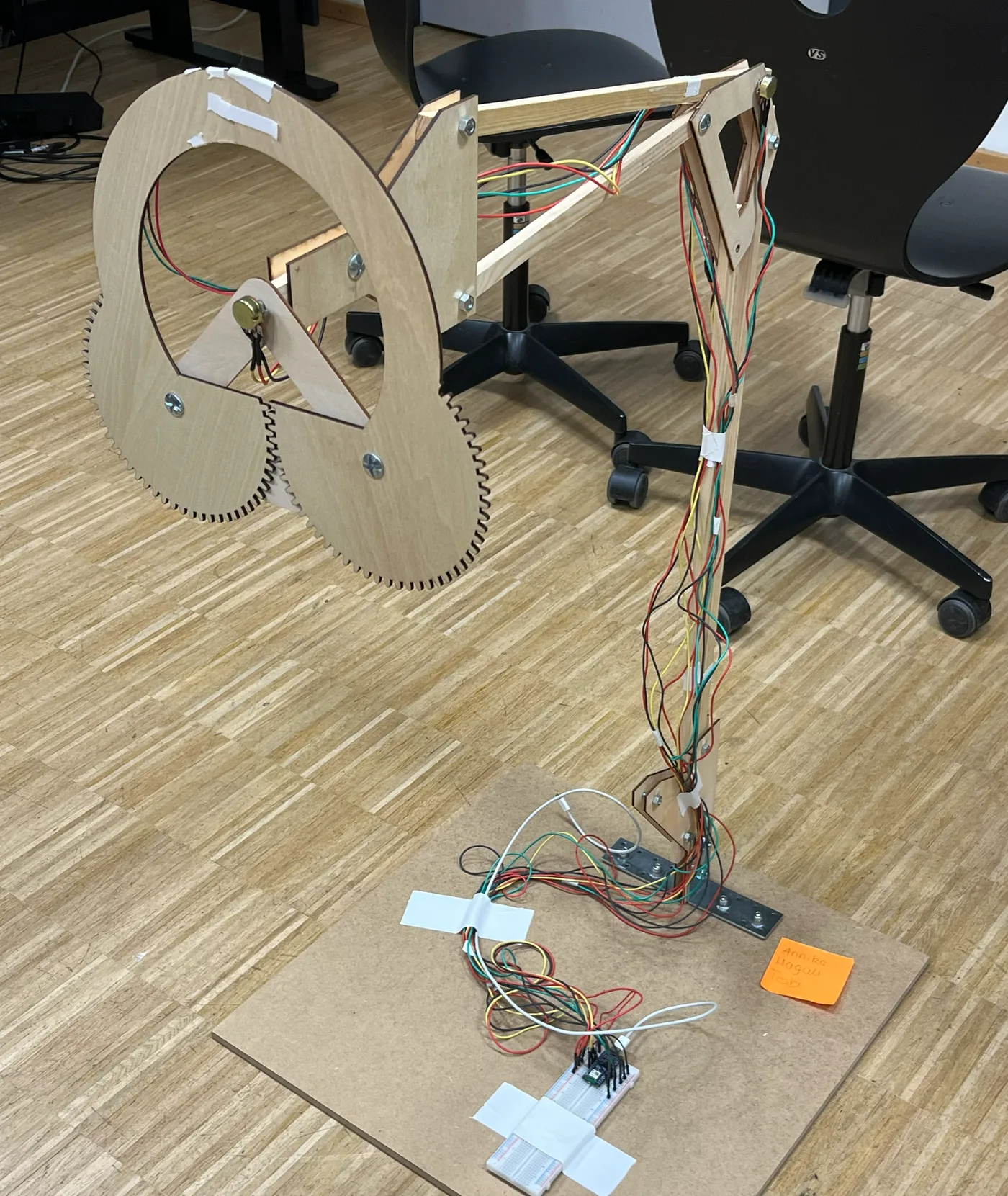
What testing revealed
In the first round of tests with HfG students, most functions were quickly matched correctly. But nobody found the mode switch for the crab walk without help. The controls were also too sensitive and the grip position unclear. For a second round I built three alternatives: foot pedals, twisting the lower joint, and two switches on the wheel. The switches were the clear winner. The pedals were mistaken for accelerators, and the extra rotation axis caused accidental input.
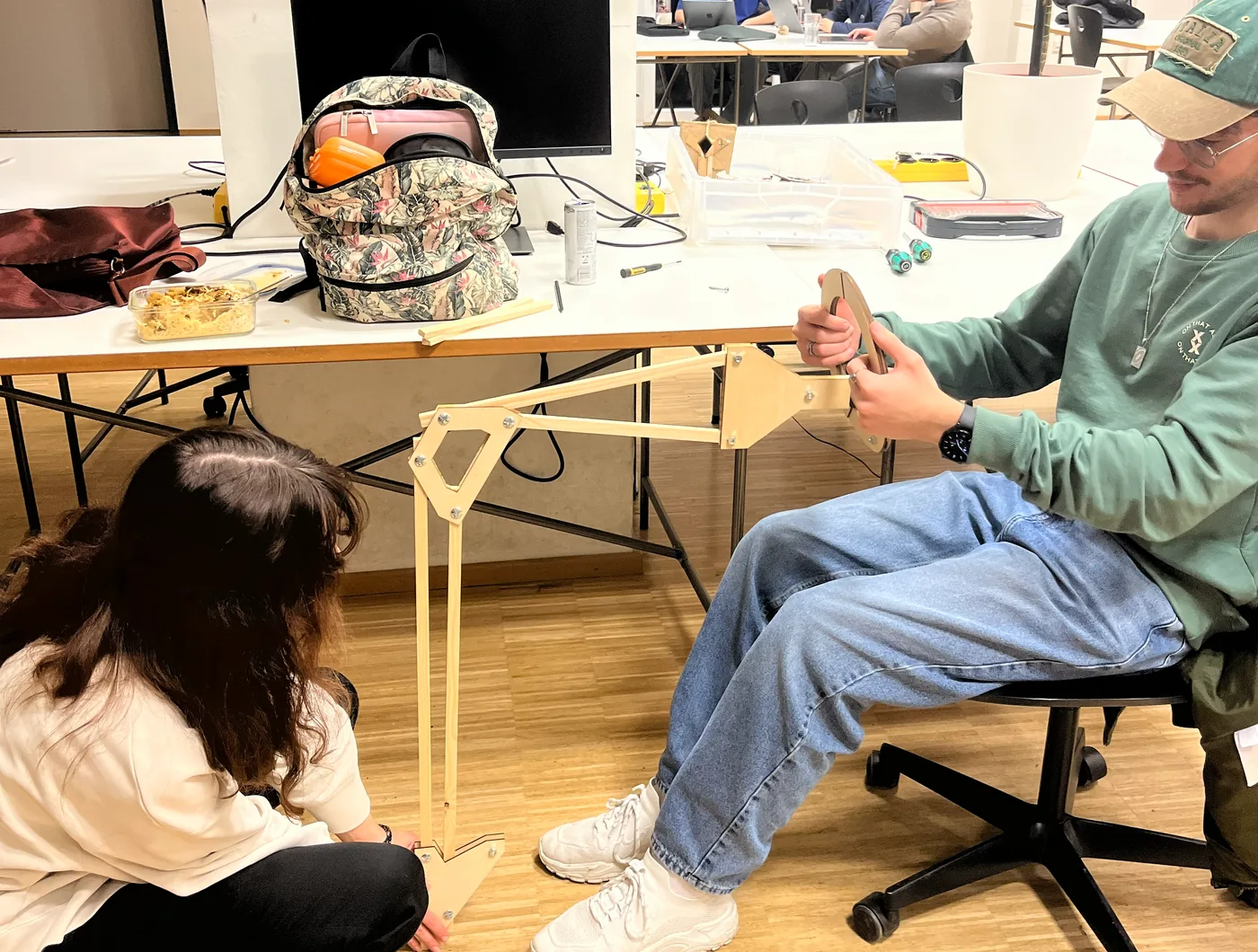
Final prototype and design
The wooden prototype broke several times during testing. For the final version I switched to 3D printing with Fusion 360 and built on the metal frame of a lamp. The potentiometers now sit on solid axles, the wheel rotation runs on two ball bearings, and two microswitches at the top of the wheel control the crab walk. After re-soldering and cleaning up the wiring, one problem remained: getting the lower joint to spring back to zero. After many attempts, a combination of a metal ruler, spring-steel rods and a folding ruler did the job.
In parallel, the team developed the design model: a dark-grey metal wheel with leather on the grip areas, a joint mechanism styled like a monitor arm, an adjustable seat on rails, and a monitor showing the robot’s surroundings.
Team, role and outlook
IOCON was created with Annika Feist and Tobias Wallisch. I built nearly all of the physical prototype myself, from the first cardboard models to the final 3D-printed version, and took main responsibility for the code, concept, ideation and user research. I contributed to the design model; the renderings were done by teammates.
Testing used a simulation with students and people from our personal circles, not trained operators, and not under real latency. The seat, footrest and ergonomic grips exist only in the design model so far.
Key data
- Course
- Interface Design 1 · Winter 2025/26
- Supervisor
- Prof. Michael Schuster
- Team
- 3
- My role
- Physical prototyping, concept, user research
- Methods
- Crazy 8s, cardboard models, 2 rounds of guided user tests, variant testing
- Tech
- Arduino (C), potentiometers, reed sensor, microswitches, laser cutter, 3D printing, Fusion 360, soldering
The ESA reference is a course use case, not a collaboration with ESA.